Friday, November 28, 2014

Rising of China: Making History or Making Future?

China maintains its world's top twenty economic growth rate in 2013, with a real GDP growth rate of 7.4%. According to statistics released in October, China still has the fastest-growing big economy, with a 7.3% expansion in the third quarter from a year earlier, but this is actually its slowest pace in more than five years. Chinese economy is almost certain this year to register its weakest annual growth rate since 1990. (Data from World Bank)

Is China making history, soaring at a speed that ? Certainly yes. China receives continual coverage in the popular press of its emerging superpower status, and has been identified as a rising economic growth and military superpower by academics and experts. Many critics hold positive view toward the rising of China. Lawrence Saez at the School of Oriental and African Studies, London, argued in 2011 that the United States will be surpassed by China as military superpower within twenty years. The Director of the China Center for Economic Reform at Peking University, Yao Yang stated that China will become the world's largest economy by 2021. (When will China become a global superpower?, Thair Shaikh)

Meanwhile, however, the doubt about the potential of China has never end. As the ironic nick name "Word Factory" implies, 83% of all high-tech products that are made in China were produced for the foreign companies. China's problems regarding wages, aging, declining population, and also gender imbalance may lead to crimes. (I don't see China becoming a superpower in this century, Timothy Beardson) However, the biggest obstacle preventing China from being regarded as superpower is its unsustainable development, the risk in managing its economic mode, population, and resources.

Is China making future, making the status quo sustainable? My answer is no. 

China’s success story is based on a single economic mode: mass production of low-value manufacturing products using abundant and cheap labor, and endless economies of scale. This mode of growth is proved to be losing its efficacy. The country’s changing demographics, aging population and rising wage costs make this system increasingly unsustainable. Most importantly, lacking technological originality and innovation, China owns very few patents featuring originality and high or core technology. Fewer than 1,000 Chinese patents have won recognition from counterparts in the U.S., Europe, or Japan (High quantity, low quality: China's patent boom, Xinhua), which is why the claim of China being able to keep its high rate of economic grow without being outsourced by western countries is highly questionable . 

Overcrowding has long been a problem the country faces, especially in those most advanced cities - can you believe that the city of Beijing is accommodating more people than New York State? (2014 revision of the World Urbanization Prospects, United Nations) Various regulation has been implemented regarding population, including the One-child Policy and Hukou System, and then comes the side effects. The former leads to aging and gender imbalance problem, with a 6:5 ratio which means that 1 in 6 males will not have a female partner. The latter increase inequality - denying rural citizens' access to many urban social services by providing services only accessible to those with permanent urban residency status. (Non-residents face hard and costly road to get around the Hukou barrier, Zhang Hong) Moreover, even though higher education in China is continuously growing, changing and developing, it is true that there are merely over 2,000 universities and colleges, with more than 6 million enrollments in total. Comparing to US's over 4500 degree-granting institutions serving more than 21 million youth (Enrollment - National Center for Education Statistics), China still has a long way to go in order to better the "quality" of its people. 

Mass production also brings the problem of over-consuming natural resources and pollution. As a result of lacking technological support, China’s cement factories use 45% more power than the world average, and its steel makers use about 20% more. (As China Roars, Pollution Reaches Deadly Extremes, Joseph Kahn and Jim Yardley) It is in fact almost impossible to see a clear blue sky in busy cities like Beijing and Shanghai, which is why several weeks ago Beijing had to shut down all factories, stop all transportation and dismiss all students and workers for a week as a deus ex machina to show members of APEC a blue sky. According to the Chinese Ministry of Health, ambient air pollution alone killed hundreds of thousands of citizens every year. Only 1% of the country’s 560 million city dwellers breathe air considered safe by the European Union, because all of its major cities are constantly covered in a "toxic gray shroud". And these are just a glimpse of industrial pollution. Soil contamination and water pollution left permanent effect on agriculture and water supply; 300 million tonnes of waste was generated in 2012 because of the small level of "environmental awareness" (Data from Waste Atlas). 

"What would you think of some one who steals from his or her grandchildren?" asked Prof. Woodhouse in the Future of Technological Civilization. Are China supposed to make history at the expense of the well-being of the descendants? Or should the country be responsible for the future of itself and its future generation? I believe that there is no ideal "sustainable development" and that there is always a trade-off between making history and making future, among which I incline to the latter. 

Sunday, November 23, 2014

Trade-off Between Leisure and "Leaning in": What Can Government Help?

Summary:
    In this post, I am going to talk about how government can positively influence on the trade-off between "more leisure time" and "leaning in".


According to Lean In by Sheryl Sandberg, the chief operating officer of Facebook, "30 years after women became 50% of the college graduates in the United States, men still hold the vast majority of leadership positions in government and industry." Despite what we’re led to believe these days, as it turns out, women’s voices are still not equally represented in major aspects of business and how the world runs. Sheryl Sandberg advocate that pursuing personal fulfillment and gender-equal representation, women should actively engage in their career and strive for a "shared earning / shared parenting marriage".

Meanwhile, according to statistics in Overwhelmed by Brigid Schulte, an award-winning journalist for the Washington Post and Washington Post magazine, American mothers have only about thirty-six minutes a day of leisure time that is spent in "pure" or child-free time to themselves. She discusses how time pressure and modern life have led to a constant feeling of being overwhelmed and to a constant sense of urgency, which is affecting our health and other physical and mental aspects. 

Seems like there's a conflict, or let's say trade-off: women lose their leisure time to themselves if they start stepping up work, yet failed to achieve their personal career goal if they have enough leisure time to enjoy lives. Two female author's different focuses somewhat indicate varying value and attitude of women. Both of them are looking for way to share parenting, the former ask for more time to work, while the latter to relax. In Denmark, the world's happiest country, it's possible to work short, productive, flexible hours and still be successful, committed workers and attentive parents. An Australian sociologist Lyn Craig found that Danish women have the most leisure time of mothers. One and a half hours of a Danish mother's leisure time every day is spent in "pure" or child-free time to themselves - as much as an hour more of leisure a day than mothers in the United States. So the issue is a bit clearer now: how can women set themselves free from child-care and housework, so that they can spend more at work or in relaxation? 

I believe that there are things government can do to help women achieve this goal. Danish policy allows mothers to take 18 weeks of maternal leave and fathers to receive their own dedicated 2 weeks at up to 100%, and provides the family additional 32 hours of paid time off to use as they see fit. This policy makes way for "shared parenting marriage" by giving parental leave to the family instead of merely to the mother. Now the family have the chance to think of the best plan for both child-caring and career fulfillment.

What's more, Danish children have access to free or low-cost child care, which frees up young mothers to return to the work force if they'd like to. Policy also ensures 79% of Danish mothers who take parental leave resume work to the same extent as before, compared to 59% of American women. It is no longer a stressful work to take good care of children and their school work, and it is no longer risky to do so. This policy really give the mother the right to choose whether she enjoys spending time with her children or she insist to "lean in". Neither of these option is risky. 

As a result of these helpful resources, women contribute 34~38% of income in Danish households with children, compared to American women, who contribute 28% of income. It is true that the more the mother is earning, the better chance she can speak up and take part in family decision making. I believe that when the mother's opinion weights more in a family, the couple is more likely to behave collaboratively in child-care issues.

(EU - Denmark: Combining work and family life successfully: http://europa.eu/epic/countries/denmark/index_en.htm)

Saturday, November 22, 2014

The Future of "Non-Proliferation Treaty" and "Not First Use"

Summary:
    In this post, I am going to introduce some potentially effective regulation on military R&D inspired by Nuclear Non-Proliferation Treaty (NPT) and Not First Use (NFU).


There have been wars and other violence since the beginning of human history, so it is not fair to blame high-tech weapons for violence. However, it is true that high-tech war enabled by high-tech weapons puts greater number of civilians and international relationships at greater risk. Besides steering military innovation to an appropriate pace, some effective regulation and treaty are necessary to restrict the usage of weapons of mass destruction.

Looking for a way to regulate weaponry R&D in a general sense, I find some existing restriction to the controversial nuclear weapon to be quotable: Nuclear Non-Proliferation Treaty (NPT) and Not First Use (NFU). 

Today, a total of eight countries have successfully detonated nuclear weapons, five of which are considered to be "nuclear-weapon states" under the terms of the NPT. Opened for signature in 1968, NPT is an international treaty designed to: 1. prevent the spread of nuclear weapons technology; 2. promote peaceful uses of nuclear energy; 3. achieve nuclear disarmament and the resulting general disarmament. 189 countries and regions are now recognized as parties of the treaty. India, Israel, North Korea, Pakistan and South Sudan are the only five countries that withdrawn the treaty. NPT non-nuclear-weapon states agree never to acquire nuclear weapons, and the NPT nuclear-weapon states in exchange agree to share the benefits of technology of nuclear energy and to pursue nuclear disarmament aimed at the ultimate elimination of their nuclear arsenals. (UN text of the treaty)

NPT effectively stopped the potential arm race of nuclear weapon, and made the future of nuclear technology beneficial to most of the world. What if some similar treaty is design for other newly introduced subject of controversy such as military drones? Will it be beneficial for both non-military-drone countries and military-drone countries to share the possibility in civil applications, nonmilitary security work, scientific research, search and rescue, while agree never to put drones into military use? Is is possible to eventually achieve the goal of military drone disarmament, focusing merely on how to promote equity in the possession of drone technology?

Besides NPT, NFU is also a pledge worth attention. The concept of NFU was brought up by China back in 1964 when the country first gained nuclear capabilities and signed NPT. It refers to a pledge by a nuclear power not to use nuclear weapons as a means of warfare unless first attacked by an adversary using nuclear weapons. It seemed to be somewhat contrary to the attitudes of other NFU parties such as the US, who reserves the right to use nuclear weapons first in the case of any conflict, yet it is later adopted by India, a nuclear-weapon country who "considers NPT as a flawed treaty and it did not recognize the need for universal, non-discriminatory verification and treatment." (text of NFU)

NFU does not care if nuclear technology will be beneficial to the country itself or others; rather, it shows how great the determination of the country is to minimize the possibility of using nuclear weapons. Being somehow even stricter than NPT, NFU is desirable in not only nuclear weapons. Before nuclear weapons, NFU was earlier applied to chemical and biological warfare. What about other controversial weapons? For example, what if countries with most drone possession declare not to send military drones to war until the adversary first uses the technology? What if all the other subject of controversy like automatic weapons, biological weapons and robotics are restricted to NFU? Will a war between countries like this considered fairer and less likely to cause unintended casualties? 

I believe that in the near future, when more superpower acquire the technology of innovative weapons such as military drones, there will be more treaties similar to NPT and pledges similar to NFU come to the table, making the technologies beneficial and eliminating the threat of military R&D. 

Sunday, November 16, 2014

Tactile Guideways in China: Potential View from a Blind Person

Summary:
      In this post, I am going to talk about tactile guideways and the "Barrier-free Project" in China, and how a blind person might think of them.


Tactile guideways might be the most common and affordable assistive technology, especially in over-crowded countries like China. There are about 5 million blind people in China, making up 18% of world's blind population and 3.8‰ of national population. As the country accommodating the largest number of blind people, China has to take care of their transportation problem. Since the first tactile guideways being built in Beijing in 1991 and the "Standard Design of Urban Barrier-free Facilities" being implemented in 2001, more and more tactile guideways are being built in urban sidewalks. In big cities such as Beijing, Shanghai and Shenzhen, it is now actually hard to find a main street sidewalk without tactile guideways. 


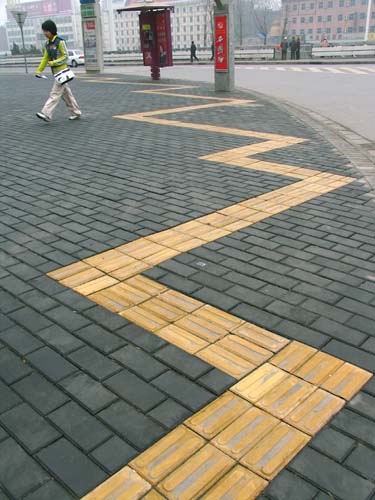
Throughout China huge strides are being made to develop more accessible places and transportation systems, especially for the old, young, and those with mobility limitations. Thousands of kilometers of tactile guideways have been laid, ramps have been made, hand rails installed, and public transportation made more accessible. As one big part of the "Barrier-free Project", tactile guideways provide way-finding aid for blind people probably more than most Western cities offer. What make up this huge project are the two types of lovely yellow standardized bricks shown above. The one with striped bulges is used to help keeping straight, while the one with round bulges is to notify change in direction.

Looks cool and helpful, huh? However, the reality is that I have only witnessed blind person walking on tactile guideways once during my entire life in the city of Shenzhen. Why? Shouldn't this obviously costly, large scaled, multi-cities governmental project be useful to and be appreciated by blind people?


Some tactile guideways are weirdly laid. Picture on the left shows a part of tactile guideways in the city of Xi'an. In a linear distance of some 20 meter, twelve left and right turns will a blind person have to come across. Putting aside all the technical difficulties, this non-humanity design will not considered helpful by any blind person, will only exist in order to make up the so-called "Barrier-free" sidewalk. Some are laid incorrectly, conflict to other permanent settings on the sidewalk. Picture on the middle show one case of a thousand. According what I've seen on the Internet and in real life, tactile guideways are often blocked by trees, mailboxes, sentry boxes, streetlamp, phone booth - you name it. Most of these cases are very dangerous for people relying on and walking on tactile guideways. Some are blocked by cars and bicycles, as shown in the picture at the bottom, indicating that people are not aware of the existence of tactile guideways. Government spent enormous amount of money on laying these yellow bricks, but failed to inform people about their significance. As a result, hardly blind people are making use of this tremendous project, leaving these yellow lanes decorations. 

Government are satisfied with the growing number of city laid tactile guideways. People are happy and positive about tactile guideways and the convenience it brings to blind people. What will a blind person think of the unhelpful tactile guideways? Their not using it would be the silence response. It seems like Chinese cities are making big efforts toward accessibility. The process takes time. With future improvements to its design and further public awareness of its significance, tactile guideways may become immensely, practically more useful for those who are visually impaired.

Agricultural Technoscience Reduces Inequity

Summary:
    In this post, I'm going to talk about three ways that agricultural technoscience reduces inequity.


The poor in developing countries remain disproportionally rural, with most employed or self-employed in agriculture. There has therefore been a longstanding interest in understanding the relationship between agricultural growth, rural development and inequity reduction. In what way does agricultural technoscience reduce poverty and increase equity? Seemingly, this effect occurs through the impact on real rural household incomes; however, I believe that there are multiple pathways linking agricultural productivity to real income changes that respond to various market forces. There is strong evidence for direct and indirect inequity reduction through food prices effects, employment generation, and rural non-farm effects.

Increased agricultural productivity generated by new agricultural technology can decrease food prices, to the benefit of all consumers in both rural and urban settings. Thanks to the Green Revolution during 1960s and 1970s, agricultural output was expanded by the introduction of a series of technological innovation including modern irrigation projects, pesticides, synthetic nitrogen fertilizer. New and improved varieties of wheat and other grains developed through conventional and science-based methods were instrumental to the green revolution. "Real prices for most agricultural commodities have declined over the past four decades." (The Future of Technological Civilization, Prof. Woodhouse) Moreover, with advances in molecular genetics, the mutant genes responsible for desirable genes such as wheat reduced-height gene and rice semi-dwarf gene were cloned. Cereal production more than doubled in developing nations during those decades and the resulting decline in food prices significantly decreased inequality and poverty, making staples more universally affordable.

Will the increase in agricultural goods supplies and the decrease in its market equilibrium prices reversely result in poverty of rural households? Not necessarily. Growth in agricultural productivity resulting from technoscientific development can increase real wage rates, which both directly and indirectly contributes to poverty alleviation. According to a data analysis in Farm Productivity and Rural Poverty in India by Gaurav Datt and Martin Ravallion, higher real wages and higher farm yields reduced absolute poverty, and even the poorest benefited from productivity gains. Moreover, increased agricultural production is likely to increase the demand for farm labor through increases in area cultivated, intensity of cultivation, and frequency of cropping. In China, even more jobs are created as a result of the "Farmer, Countryside, and Agriculture" policies, implemented in early 2004. Increasing number of agricultural technology and biochemistry specialist entered countrysides, providing hands-on technological assistance and to farmers, guiding farmers to increase productivity with latest technology. Meanwhile, more and more political and economic professions visits rural families, helping farmers to manage their cultivation according to the market and policies and maximize profit by making full use of available resources and farmlands. These personnel now don't have to worry about getting a decent job in highly competitive urban organizations and firms, because farmers always need their technological assistance and are willing to pay them high wages. Therefore inequity is reduced.

Increased agricultural production creates demand for products and services related to agricultural input and output. Besides the increased need of professional assistance I have mentioned, which is a direct benefit from input of services for agriculture, there are also parts that being benefited indirectly such as processing, storage and transport. This benefit tends to be more dynamic and equitable in areas where agriculture thrives with the help of agricultural technology. Where agriculture performs poorly, employment in the rural non-farm economy is often an option of last resort offering extremely low wages. Moreover, It also generates consumption links as farmers and farm laborers spend increased incomes on goods and services. Non-poor farmers now are willing to purchase electronics and better furniture to better living condition and diversify livelihood, which indirectly reduces inequity by generating more job opportunities and by diminishing the gap between urban life and rural life.

Monday, November 10, 2014

Questionable Search Engines: Why and How They Are Biased

Recently, Berlin called on Google to disclose the details of its secret algorithms that had allowed it to monopolize web search in Europe, in a move that was likely to be welcomed by competitors and fiercely resisted by Google. Actually, Claims of bias are nothing new to Google. According to The Economic Times, "pressure is growing on Google to lift the veil on some of its inner workings as European regulators investigate complaints that Google's search engine unfairly discriminates against certain websites" by the European Union.

Increasingly, the quality of Google's search results and business practices are being called into question, and almost all the blames are pointed toward the its algorithm, the “secret sauce recipe” that has enabled it to dominate the field of web page searching. In computer science, an algorithm is the description of an automated solution to a problem. Some algorithms are inherently biased, such as those designed to generate a random number, which exceed the capability of a computer, while most of them are artificial. The artificial bias of searching is often referred to the practice of causing a web page to rank highly in search engine results for unrelated or off-topic search terms by linking heavily, known as Google Bombing. So how and why algorithms of such searching engine are intentionally designed to be 'biased'?


1. A result of user preference

Search engines now aspire to develop "perfect recall" of all of their users. To do this, information providers must not just track their users, they must also "build technical infrastructures and business models that link individual sites into a suite of services, or an even broader ecosystem. And then create incentives for users to remain within it." (The Relevance of Algorithms, Tarleton Gillespie) Today we call the algorithms lies behind these behaviors "big data", storing user preferences in the Cloud, so any device with a network connection and a method to "identify" the user can use these preferences to provide most relevant and desirable results of searching.

Even though sometimes repetitively appeared relevant searching result and advertisement are pretty annoying, and excessively recording user preference is now considered to be immoral and potentially fatal to information security, I still believe that big data has a broad prospective in better one's searching experience, accompanied by more advanced governmental regulation, and solutions to ethical and security problems.

2. A result of economic and commercial processes

Baidu, the most influential search engine in China owning world's second biggest share of the search engine market, has always been controversial about its algorithms and its way of making profit "Baidu Popularization". Searching the word "bicycle" on Baidu, you will find that the top ranking results are almost all advertisement - links direct you to bicycle companies and their product pages. It also provides the ranking based on how much money those companies are paying to promote, and even forces some small companies to pay by putting their links far far behind where they should be.

Besides promoting its own business, by studying what types of ranking manipulations a search engine is using, a company can also provoke a search engine into lowering the ranking of a competitor's website by purchasing Google Bombing services for the website of a competitor. The attacker provokes the search company into punishing the competitor by displaying their page further down in the search results, forming an unhealthy and potentially illegal part of the booming technological community.

Google Bombing is also potentially a result from inter-companies competition. Broadly acknowledged as the first ever Google bomb came about back in 1999 when many people were still on dial-up connections. A search for "more evil than Satan himself" resulted in the Microsoft homepage as the top result. In 2011, Bing defined the search for “more evil than Satan himself” as 10^100 (a googol, the word the Google founders used as the basis of their company’s name). These definitions were obviously chosen by both teams, instead of results of errant algorithms.
In stead of being modified by users or the search engine itself, sometimes a third party, more specifically the website that wants to boost its popularity, can also make the algorithm or the search result biased. Owner of an Internet domain name could set up the domain's DNS entry so that all sub-domains are directed to the same server. In this way a page full of desired Google search terms, each linking to a sub-domain of the same site will be generate.

3. A result of political processes

During the 2004 U.S. presidential election, Google bombs were used to further various political agendas. Searching "miserable failure" on Google would link you to George W. Bush's White House biography and "waffles" to John Kerry's website. Names of some public figures were also being displayed when searching words like "scandal", "rumor" and "private photos". It was not until 2007 that Google changed their indexing structure so that Google bombs such as "miserable failure" would "typically return commentary, discussions, and articles" about the tactic itself, instead of prospectively depreciating individuals.

Google is also adapted to local policies of different countries and regions, especially in China and European Union. Censorship is designed to protect copyright of books, music and movies, as well as private information, adult content and unethical contents.


Is algorithm biased? In my opinion, the answer is YES. Algorithm embodies in search engines is human-written and human-oriented, composed with not only programmers' frosty codes, but also with their faith and opinions.

Thursday, November 6, 2014

Steering Molecular Manufacturing: Potential Risk of Inequity

When I was told about 3D printing, a 'street name' of molecular manufacturing, by my father a year ago, I literally took it as a joke. I remember I spent nearly half an hour, using all the thing that I have learnt in high school chemistry class, persuading him that it was just an ideal way of manufacturing. I told him that even it somehow become possible in the future, it would still be too costly compared to traditional factories in China. 

Today, the drastically development of molecular manufacturing is proving me wrong. Even though the fictional 3D printing still have not yet realized, the widespread use of nanotechnology in medicine, biology and energy is making the day closer and closer. Today the theories for using mechanical chemistry to directly fabricate nanoscale structures are well-developed and awaiting progress in enabling technologies. If all these theories work, exponentially soaring molecular manufacturing appears to be inevitable. 

"The possible implications ... are impossible to estimate, but it is at least conceivable that Chinese factories - and hence the employment of a hundred million or more - could be negatively impacted" In The Future of Technological Civilization, Prof. Woodhouse expresses his concern on molecular manufacturing negatively effect job opportunity available, economically known as 'structural unemployment'. 

However, I see the potential risk of inequity initiated by molecular manufacturing more influential then merely revolutionizing sweatshop labor. When you purchase a pair of sneakers on Amazon, you are paying for its design, raw materials, the labor and capital of manufacturing, transportation, storage, and sales. Fairly small amount of money goes to the owners of all these businesses. If personal nanofactories can produce a wide variety of products when and where they are wanted, most of this effort will become unnecessary. This raises several questions about the post-nanotechnological economy: Will capitalism disappear? Will people be unemployed? Will the availability of 3D copying mean that even the designers and copyright owners don't get paid?And if nanofactory technology is exclusively owned or controlled, will this create the world's biggest monopoly, with abusive anti-competitive practices?

Inequity happens not only when job opportunity in not equally available, but also when the market equilibrium is broken, which may lead to unfair distribution of accessibility of goods and services. Owners of nanotechnology may charge high rates for all products, and make high profits. Such a practice would deny cheap lifesaving technologies such as water filters or mosquito netting to millions of people in desperate need. The benefit and convenience of the new technology may not be converted to the poor; rather, stays as a tool for capitalists to gain more profit. 

How can scientists, businesses, and government work together to ensure positive impact of nanotechnology? This will be an important study to get the world ready for a brave new era, involving new governmental regulations, new marketing strategies, new direction in education.