Friday, November 28, 2014

Rising of China: Making History or Making Future?

China maintains its world's top twenty economic growth rate in 2013, with a real GDP growth rate of 7.4%. According to statistics released in October, China still has the fastest-growing big economy, with a 7.3% expansion in the third quarter from a year earlier, but this is actually its slowest pace in more than five years. Chinese economy is almost certain this year to register its weakest annual growth rate since 1990. (Data from World Bank)

Is China making history, soaring at a speed that ? Certainly yes. China receives continual coverage in the popular press of its emerging superpower status, and has been identified as a rising economic growth and military superpower by academics and experts. Many critics hold positive view toward the rising of China. Lawrence Saez at the School of Oriental and African Studies, London, argued in 2011 that the United States will be surpassed by China as military superpower within twenty years. The Director of the China Center for Economic Reform at Peking University, Yao Yang stated that China will become the world's largest economy by 2021. (When will China become a global superpower?, Thair Shaikh)

Meanwhile, however, the doubt about the potential of China has never end. As the ironic nick name "Word Factory" implies, 83% of all high-tech products that are made in China were produced for the foreign companies. China's problems regarding wages, aging, declining population, and also gender imbalance may lead to crimes. (I don't see China becoming a superpower in this century, Timothy Beardson) However, the biggest obstacle preventing China from being regarded as superpower is its unsustainable development, the risk in managing its economic mode, population, and resources.

Is China making future, making the status quo sustainable? My answer is no. 

China’s success story is based on a single economic mode: mass production of low-value manufacturing products using abundant and cheap labor, and endless economies of scale. This mode of growth is proved to be losing its efficacy. The country’s changing demographics, aging population and rising wage costs make this system increasingly unsustainable. Most importantly, lacking technological originality and innovation, China owns very few patents featuring originality and high or core technology. Fewer than 1,000 Chinese patents have won recognition from counterparts in the U.S., Europe, or Japan (High quantity, low quality: China's patent boom, Xinhua), which is why the claim of China being able to keep its high rate of economic grow without being outsourced by western countries is highly questionable . 

Overcrowding has long been a problem the country faces, especially in those most advanced cities - can you believe that the city of Beijing is accommodating more people than New York State? (2014 revision of the World Urbanization Prospects, United Nations) Various regulation has been implemented regarding population, including the One-child Policy and Hukou System, and then comes the side effects. The former leads to aging and gender imbalance problem, with a 6:5 ratio which means that 1 in 6 males will not have a female partner. The latter increase inequality - denying rural citizens' access to many urban social services by providing services only accessible to those with permanent urban residency status. (Non-residents face hard and costly road to get around the Hukou barrier, Zhang Hong) Moreover, even though higher education in China is continuously growing, changing and developing, it is true that there are merely over 2,000 universities and colleges, with more than 6 million enrollments in total. Comparing to US's over 4500 degree-granting institutions serving more than 21 million youth (Enrollment - National Center for Education Statistics), China still has a long way to go in order to better the "quality" of its people. 

Mass production also brings the problem of over-consuming natural resources and pollution. As a result of lacking technological support, China’s cement factories use 45% more power than the world average, and its steel makers use about 20% more. (As China Roars, Pollution Reaches Deadly Extremes, Joseph Kahn and Jim Yardley) It is in fact almost impossible to see a clear blue sky in busy cities like Beijing and Shanghai, which is why several weeks ago Beijing had to shut down all factories, stop all transportation and dismiss all students and workers for a week as a deus ex machina to show members of APEC a blue sky. According to the Chinese Ministry of Health, ambient air pollution alone killed hundreds of thousands of citizens every year. Only 1% of the country’s 560 million city dwellers breathe air considered safe by the European Union, because all of its major cities are constantly covered in a "toxic gray shroud". And these are just a glimpse of industrial pollution. Soil contamination and water pollution left permanent effect on agriculture and water supply; 300 million tonnes of waste was generated in 2012 because of the small level of "environmental awareness" (Data from Waste Atlas). 

"What would you think of some one who steals from his or her grandchildren?" asked Prof. Woodhouse in the Future of Technological Civilization. Are China supposed to make history at the expense of the well-being of the descendants? Or should the country be responsible for the future of itself and its future generation? I believe that there is no ideal "sustainable development" and that there is always a trade-off between making history and making future, among which I incline to the latter. 

Sunday, November 23, 2014

Trade-off Between Leisure and "Leaning in": What Can Government Help?

Summary:
    In this post, I am going to talk about how government can positively influence on the trade-off between "more leisure time" and "leaning in".


According to Lean In by Sheryl Sandberg, the chief operating officer of Facebook, "30 years after women became 50% of the college graduates in the United States, men still hold the vast majority of leadership positions in government and industry." Despite what we’re led to believe these days, as it turns out, women’s voices are still not equally represented in major aspects of business and how the world runs. Sheryl Sandberg advocate that pursuing personal fulfillment and gender-equal representation, women should actively engage in their career and strive for a "shared earning / shared parenting marriage".

Meanwhile, according to statistics in Overwhelmed by Brigid Schulte, an award-winning journalist for the Washington Post and Washington Post magazine, American mothers have only about thirty-six minutes a day of leisure time that is spent in "pure" or child-free time to themselves. She discusses how time pressure and modern life have led to a constant feeling of being overwhelmed and to a constant sense of urgency, which is affecting our health and other physical and mental aspects. 

Seems like there's a conflict, or let's say trade-off: women lose their leisure time to themselves if they start stepping up work, yet failed to achieve their personal career goal if they have enough leisure time to enjoy lives. Two female author's different focuses somewhat indicate varying value and attitude of women. Both of them are looking for way to share parenting, the former ask for more time to work, while the latter to relax. In Denmark, the world's happiest country, it's possible to work short, productive, flexible hours and still be successful, committed workers and attentive parents. An Australian sociologist Lyn Craig found that Danish women have the most leisure time of mothers. One and a half hours of a Danish mother's leisure time every day is spent in "pure" or child-free time to themselves - as much as an hour more of leisure a day than mothers in the United States. So the issue is a bit clearer now: how can women set themselves free from child-care and housework, so that they can spend more at work or in relaxation? 

I believe that there are things government can do to help women achieve this goal. Danish policy allows mothers to take 18 weeks of maternal leave and fathers to receive their own dedicated 2 weeks at up to 100%, and provides the family additional 32 hours of paid time off to use as they see fit. This policy makes way for "shared parenting marriage" by giving parental leave to the family instead of merely to the mother. Now the family have the chance to think of the best plan for both child-caring and career fulfillment.

What's more, Danish children have access to free or low-cost child care, which frees up young mothers to return to the work force if they'd like to. Policy also ensures 79% of Danish mothers who take parental leave resume work to the same extent as before, compared to 59% of American women. It is no longer a stressful work to take good care of children and their school work, and it is no longer risky to do so. This policy really give the mother the right to choose whether she enjoys spending time with her children or she insist to "lean in". Neither of these option is risky. 

As a result of these helpful resources, women contribute 34~38% of income in Danish households with children, compared to American women, who contribute 28% of income. It is true that the more the mother is earning, the better chance she can speak up and take part in family decision making. I believe that when the mother's opinion weights more in a family, the couple is more likely to behave collaboratively in child-care issues.

(EU - Denmark: Combining work and family life successfully: http://europa.eu/epic/countries/denmark/index_en.htm)

Saturday, November 22, 2014

The Future of "Non-Proliferation Treaty" and "Not First Use"

Summary:
    In this post, I am going to introduce some potentially effective regulation on military R&D inspired by Nuclear Non-Proliferation Treaty (NPT) and Not First Use (NFU).


There have been wars and other violence since the beginning of human history, so it is not fair to blame high-tech weapons for violence. However, it is true that high-tech war enabled by high-tech weapons puts greater number of civilians and international relationships at greater risk. Besides steering military innovation to an appropriate pace, some effective regulation and treaty are necessary to restrict the usage of weapons of mass destruction.

Looking for a way to regulate weaponry R&D in a general sense, I find some existing restriction to the controversial nuclear weapon to be quotable: Nuclear Non-Proliferation Treaty (NPT) and Not First Use (NFU). 

Today, a total of eight countries have successfully detonated nuclear weapons, five of which are considered to be "nuclear-weapon states" under the terms of the NPT. Opened for signature in 1968, NPT is an international treaty designed to: 1. prevent the spread of nuclear weapons technology; 2. promote peaceful uses of nuclear energy; 3. achieve nuclear disarmament and the resulting general disarmament. 189 countries and regions are now recognized as parties of the treaty. India, Israel, North Korea, Pakistan and South Sudan are the only five countries that withdrawn the treaty. NPT non-nuclear-weapon states agree never to acquire nuclear weapons, and the NPT nuclear-weapon states in exchange agree to share the benefits of technology of nuclear energy and to pursue nuclear disarmament aimed at the ultimate elimination of their nuclear arsenals. (UN text of the treaty)

NPT effectively stopped the potential arm race of nuclear weapon, and made the future of nuclear technology beneficial to most of the world. What if some similar treaty is design for other newly introduced subject of controversy such as military drones? Will it be beneficial for both non-military-drone countries and military-drone countries to share the possibility in civil applications, nonmilitary security work, scientific research, search and rescue, while agree never to put drones into military use? Is is possible to eventually achieve the goal of military drone disarmament, focusing merely on how to promote equity in the possession of drone technology?

Besides NPT, NFU is also a pledge worth attention. The concept of NFU was brought up by China back in 1964 when the country first gained nuclear capabilities and signed NPT. It refers to a pledge by a nuclear power not to use nuclear weapons as a means of warfare unless first attacked by an adversary using nuclear weapons. It seemed to be somewhat contrary to the attitudes of other NFU parties such as the US, who reserves the right to use nuclear weapons first in the case of any conflict, yet it is later adopted by India, a nuclear-weapon country who "considers NPT as a flawed treaty and it did not recognize the need for universal, non-discriminatory verification and treatment." (text of NFU)

NFU does not care if nuclear technology will be beneficial to the country itself or others; rather, it shows how great the determination of the country is to minimize the possibility of using nuclear weapons. Being somehow even stricter than NPT, NFU is desirable in not only nuclear weapons. Before nuclear weapons, NFU was earlier applied to chemical and biological warfare. What about other controversial weapons? For example, what if countries with most drone possession declare not to send military drones to war until the adversary first uses the technology? What if all the other subject of controversy like automatic weapons, biological weapons and robotics are restricted to NFU? Will a war between countries like this considered fairer and less likely to cause unintended casualties? 

I believe that in the near future, when more superpower acquire the technology of innovative weapons such as military drones, there will be more treaties similar to NPT and pledges similar to NFU come to the table, making the technologies beneficial and eliminating the threat of military R&D. 

Sunday, November 16, 2014

Tactile Guideways in China: Potential View from a Blind Person

Summary:
      In this post, I am going to talk about tactile guideways and the "Barrier-free Project" in China, and how a blind person might think of them.


Tactile guideways might be the most common and affordable assistive technology, especially in over-crowded countries like China. There are about 5 million blind people in China, making up 18% of world's blind population and 3.8‰ of national population. As the country accommodating the largest number of blind people, China has to take care of their transportation problem. Since the first tactile guideways being built in Beijing in 1991 and the "Standard Design of Urban Barrier-free Facilities" being implemented in 2001, more and more tactile guideways are being built in urban sidewalks. In big cities such as Beijing, Shanghai and Shenzhen, it is now actually hard to find a main street sidewalk without tactile guideways. 


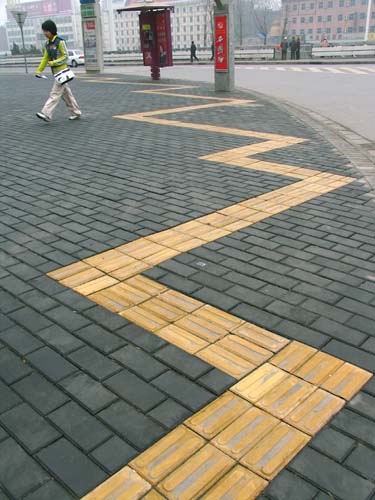
Throughout China huge strides are being made to develop more accessible places and transportation systems, especially for the old, young, and those with mobility limitations. Thousands of kilometers of tactile guideways have been laid, ramps have been made, hand rails installed, and public transportation made more accessible. As one big part of the "Barrier-free Project", tactile guideways provide way-finding aid for blind people probably more than most Western cities offer. What make up this huge project are the two types of lovely yellow standardized bricks shown above. The one with striped bulges is used to help keeping straight, while the one with round bulges is to notify change in direction.

Looks cool and helpful, huh? However, the reality is that I have only witnessed blind person walking on tactile guideways once during my entire life in the city of Shenzhen. Why? Shouldn't this obviously costly, large scaled, multi-cities governmental project be useful to and be appreciated by blind people?


Some tactile guideways are weirdly laid. Picture on the left shows a part of tactile guideways in the city of Xi'an. In a linear distance of some 20 meter, twelve left and right turns will a blind person have to come across. Putting aside all the technical difficulties, this non-humanity design will not considered helpful by any blind person, will only exist in order to make up the so-called "Barrier-free" sidewalk. Some are laid incorrectly, conflict to other permanent settings on the sidewalk. Picture on the middle show one case of a thousand. According what I've seen on the Internet and in real life, tactile guideways are often blocked by trees, mailboxes, sentry boxes, streetlamp, phone booth - you name it. Most of these cases are very dangerous for people relying on and walking on tactile guideways. Some are blocked by cars and bicycles, as shown in the picture at the bottom, indicating that people are not aware of the existence of tactile guideways. Government spent enormous amount of money on laying these yellow bricks, but failed to inform people about their significance. As a result, hardly blind people are making use of this tremendous project, leaving these yellow lanes decorations. 

Government are satisfied with the growing number of city laid tactile guideways. People are happy and positive about tactile guideways and the convenience it brings to blind people. What will a blind person think of the unhelpful tactile guideways? Their not using it would be the silence response. It seems like Chinese cities are making big efforts toward accessibility. The process takes time. With future improvements to its design and further public awareness of its significance, tactile guideways may become immensely, practically more useful for those who are visually impaired.

Agricultural Technoscience Reduces Inequity

Summary:
    In this post, I'm going to talk about three ways that agricultural technoscience reduces inequity.


The poor in developing countries remain disproportionally rural, with most employed or self-employed in agriculture. There has therefore been a longstanding interest in understanding the relationship between agricultural growth, rural development and inequity reduction. In what way does agricultural technoscience reduce poverty and increase equity? Seemingly, this effect occurs through the impact on real rural household incomes; however, I believe that there are multiple pathways linking agricultural productivity to real income changes that respond to various market forces. There is strong evidence for direct and indirect inequity reduction through food prices effects, employment generation, and rural non-farm effects.

Increased agricultural productivity generated by new agricultural technology can decrease food prices, to the benefit of all consumers in both rural and urban settings. Thanks to the Green Revolution during 1960s and 1970s, agricultural output was expanded by the introduction of a series of technological innovation including modern irrigation projects, pesticides, synthetic nitrogen fertilizer. New and improved varieties of wheat and other grains developed through conventional and science-based methods were instrumental to the green revolution. "Real prices for most agricultural commodities have declined over the past four decades." (The Future of Technological Civilization, Prof. Woodhouse) Moreover, with advances in molecular genetics, the mutant genes responsible for desirable genes such as wheat reduced-height gene and rice semi-dwarf gene were cloned. Cereal production more than doubled in developing nations during those decades and the resulting decline in food prices significantly decreased inequality and poverty, making staples more universally affordable.

Will the increase in agricultural goods supplies and the decrease in its market equilibrium prices reversely result in poverty of rural households? Not necessarily. Growth in agricultural productivity resulting from technoscientific development can increase real wage rates, which both directly and indirectly contributes to poverty alleviation. According to a data analysis in Farm Productivity and Rural Poverty in India by Gaurav Datt and Martin Ravallion, higher real wages and higher farm yields reduced absolute poverty, and even the poorest benefited from productivity gains. Moreover, increased agricultural production is likely to increase the demand for farm labor through increases in area cultivated, intensity of cultivation, and frequency of cropping. In China, even more jobs are created as a result of the "Farmer, Countryside, and Agriculture" policies, implemented in early 2004. Increasing number of agricultural technology and biochemistry specialist entered countrysides, providing hands-on technological assistance and to farmers, guiding farmers to increase productivity with latest technology. Meanwhile, more and more political and economic professions visits rural families, helping farmers to manage their cultivation according to the market and policies and maximize profit by making full use of available resources and farmlands. These personnel now don't have to worry about getting a decent job in highly competitive urban organizations and firms, because farmers always need their technological assistance and are willing to pay them high wages. Therefore inequity is reduced.

Increased agricultural production creates demand for products and services related to agricultural input and output. Besides the increased need of professional assistance I have mentioned, which is a direct benefit from input of services for agriculture, there are also parts that being benefited indirectly such as processing, storage and transport. This benefit tends to be more dynamic and equitable in areas where agriculture thrives with the help of agricultural technology. Where agriculture performs poorly, employment in the rural non-farm economy is often an option of last resort offering extremely low wages. Moreover, It also generates consumption links as farmers and farm laborers spend increased incomes on goods and services. Non-poor farmers now are willing to purchase electronics and better furniture to better living condition and diversify livelihood, which indirectly reduces inequity by generating more job opportunities and by diminishing the gap between urban life and rural life.

Monday, November 10, 2014

Questionable Search Engines: Why and How They Are Biased

Recently, Berlin called on Google to disclose the details of its secret algorithms that had allowed it to monopolize web search in Europe, in a move that was likely to be welcomed by competitors and fiercely resisted by Google. Actually, Claims of bias are nothing new to Google. According to The Economic Times, "pressure is growing on Google to lift the veil on some of its inner workings as European regulators investigate complaints that Google's search engine unfairly discriminates against certain websites" by the European Union.

Increasingly, the quality of Google's search results and business practices are being called into question, and almost all the blames are pointed toward the its algorithm, the “secret sauce recipe” that has enabled it to dominate the field of web page searching. In computer science, an algorithm is the description of an automated solution to a problem. Some algorithms are inherently biased, such as those designed to generate a random number, which exceed the capability of a computer, while most of them are artificial. The artificial bias of searching is often referred to the practice of causing a web page to rank highly in search engine results for unrelated or off-topic search terms by linking heavily, known as Google Bombing. So how and why algorithms of such searching engine are intentionally designed to be 'biased'?


1. A result of user preference

Search engines now aspire to develop "perfect recall" of all of their users. To do this, information providers must not just track their users, they must also "build technical infrastructures and business models that link individual sites into a suite of services, or an even broader ecosystem. And then create incentives for users to remain within it." (The Relevance of Algorithms, Tarleton Gillespie) Today we call the algorithms lies behind these behaviors "big data", storing user preferences in the Cloud, so any device with a network connection and a method to "identify" the user can use these preferences to provide most relevant and desirable results of searching.

Even though sometimes repetitively appeared relevant searching result and advertisement are pretty annoying, and excessively recording user preference is now considered to be immoral and potentially fatal to information security, I still believe that big data has a broad prospective in better one's searching experience, accompanied by more advanced governmental regulation, and solutions to ethical and security problems.

2. A result of economic and commercial processes

Baidu, the most influential search engine in China owning world's second biggest share of the search engine market, has always been controversial about its algorithms and its way of making profit "Baidu Popularization". Searching the word "bicycle" on Baidu, you will find that the top ranking results are almost all advertisement - links direct you to bicycle companies and their product pages. It also provides the ranking based on how much money those companies are paying to promote, and even forces some small companies to pay by putting their links far far behind where they should be.

Besides promoting its own business, by studying what types of ranking manipulations a search engine is using, a company can also provoke a search engine into lowering the ranking of a competitor's website by purchasing Google Bombing services for the website of a competitor. The attacker provokes the search company into punishing the competitor by displaying their page further down in the search results, forming an unhealthy and potentially illegal part of the booming technological community.

Google Bombing is also potentially a result from inter-companies competition. Broadly acknowledged as the first ever Google bomb came about back in 1999 when many people were still on dial-up connections. A search for "more evil than Satan himself" resulted in the Microsoft homepage as the top result. In 2011, Bing defined the search for “more evil than Satan himself” as 10^100 (a googol, the word the Google founders used as the basis of their company’s name). These definitions were obviously chosen by both teams, instead of results of errant algorithms.
In stead of being modified by users or the search engine itself, sometimes a third party, more specifically the website that wants to boost its popularity, can also make the algorithm or the search result biased. Owner of an Internet domain name could set up the domain's DNS entry so that all sub-domains are directed to the same server. In this way a page full of desired Google search terms, each linking to a sub-domain of the same site will be generate.

3. A result of political processes

During the 2004 U.S. presidential election, Google bombs were used to further various political agendas. Searching "miserable failure" on Google would link you to George W. Bush's White House biography and "waffles" to John Kerry's website. Names of some public figures were also being displayed when searching words like "scandal", "rumor" and "private photos". It was not until 2007 that Google changed their indexing structure so that Google bombs such as "miserable failure" would "typically return commentary, discussions, and articles" about the tactic itself, instead of prospectively depreciating individuals.

Google is also adapted to local policies of different countries and regions, especially in China and European Union. Censorship is designed to protect copyright of books, music and movies, as well as private information, adult content and unethical contents.


Is algorithm biased? In my opinion, the answer is YES. Algorithm embodies in search engines is human-written and human-oriented, composed with not only programmers' frosty codes, but also with their faith and opinions.

Thursday, November 6, 2014

Steering Molecular Manufacturing: Potential Risk of Inequity

When I was told about 3D printing, a 'street name' of molecular manufacturing, by my father a year ago, I literally took it as a joke. I remember I spent nearly half an hour, using all the thing that I have learnt in high school chemistry class, persuading him that it was just an ideal way of manufacturing. I told him that even it somehow become possible in the future, it would still be too costly compared to traditional factories in China. 

Today, the drastically development of molecular manufacturing is proving me wrong. Even though the fictional 3D printing still have not yet realized, the widespread use of nanotechnology in medicine, biology and energy is making the day closer and closer. Today the theories for using mechanical chemistry to directly fabricate nanoscale structures are well-developed and awaiting progress in enabling technologies. If all these theories work, exponentially soaring molecular manufacturing appears to be inevitable. 

"The possible implications ... are impossible to estimate, but it is at least conceivable that Chinese factories - and hence the employment of a hundred million or more - could be negatively impacted" In The Future of Technological Civilization, Prof. Woodhouse expresses his concern on molecular manufacturing negatively effect job opportunity available, economically known as 'structural unemployment'. 

However, I see the potential risk of inequity initiated by molecular manufacturing more influential then merely revolutionizing sweatshop labor. When you purchase a pair of sneakers on Amazon, you are paying for its design, raw materials, the labor and capital of manufacturing, transportation, storage, and sales. Fairly small amount of money goes to the owners of all these businesses. If personal nanofactories can produce a wide variety of products when and where they are wanted, most of this effort will become unnecessary. This raises several questions about the post-nanotechnological economy: Will capitalism disappear? Will people be unemployed? Will the availability of 3D copying mean that even the designers and copyright owners don't get paid?And if nanofactory technology is exclusively owned or controlled, will this create the world's biggest monopoly, with abusive anti-competitive practices?

Inequity happens not only when job opportunity in not equally available, but also when the market equilibrium is broken, which may lead to unfair distribution of accessibility of goods and services. Owners of nanotechnology may charge high rates for all products, and make high profits. Such a practice would deny cheap lifesaving technologies such as water filters or mosquito netting to millions of people in desperate need. The benefit and convenience of the new technology may not be converted to the poor; rather, stays as a tool for capitalists to gain more profit. 

How can scientists, businesses, and government work together to ensure positive impact of nanotechnology? This will be an important study to get the world ready for a brave new era, involving new governmental regulations, new marketing strategies, new direction in education. 

Wednesday, November 5, 2014

Face the Pitfall in Trial and Error Learning of Drones: Potentially Unacceptable Risks

Drone is desirable in many ways. They are usually deployed for military and special operation applications, but also used in a number of civil applications, nonmilitary security work, scientific research, search and rescue, and a lot more. They are often preferred for missions that are too 'dull, dirty or dangerous' for manned aircraft. As you can see the newly introduced drone delivery of packages, drone is being widely used and is proved to be faster and easier to operate than manned vehicles. Optimistically, drones evidently better our lives, and securer our pilots.

And military drones will also be appreciated without a doubt if the security of innocent people can be assured. With its numerous advantages in targeted strike, the assassin machines known as weaponized drones grew into Obama's Favorite war machine. By 2014, Obama has authorized almost seven times as many as Bush did: about 320 strikes to Bush's 52, killing more than three thousand people. Around 2% of those killed were high-level terrorist targets - hardly a sufficient number of military targets to justify the attacks under international and domestic law conceptions of military proportionality in civilian-soldier death ratios.

Is this an unintended consequence? Definitely no. Letting its operator comfortably sitting thousands of miles away from the battle field, looking at a screen displaying a bird's-eye view of the foreign continent, military drone is designed to conduct surveillance with powerful cameras and sensors, to see human as bug. Laser-guided Hellfire missiles, the weapon carried on the most notorious weaponized drone "Predator", is also incapable to perform neither "assassin" nor "targeted strike". It is almost impossible to kill one or two suspect using a missile without harming people or destroying properties nearby.

"A misguided innovation may produce unbearably costly outcomes ... if (this pitfall) can be avoided, then trial-and-error learning will be more probable, faster, and less damaging." (The Future of Technological Civilization, Edward Woodhouse) In trying to accelerate the trial and error learning of drone, how can technoscientists and others participating in the development of military drone cope with this potentially unbearable risk, the risk of killing innocent people?

The first way would be upgrading the weapon system. Since the official purpose of drone strike is " to mitigate threats to U.S. persons' lives ... The president ... don't like the fact that people have to die. And so he wants to make sure that we go through a rigorous checklist: The infeasibility of capture, the certainty of the intelligence base, the imminence of the threat ... " (John O. Brennan, Obama's counter-terrorism adviser) It is Taliban terrorists that stand against the US government and people's security. It has nothing to do with the country of Pakistan nor its citizens. Dying under the throne and dying under terrorism actually make no difference to armless civilians. Based on the advanced technology on aerial monitoring, why not install a weapon similar to sniper rifle on drones, instead of missile of lethal, massive destruction? This would probably lower the rate of mission succeed, but as the same time effectively lower the rate of killing innocent people.

Based on the first strategy, the second way would be testing the weapon the drone is using. Let drone operators realize the outcome of pressing the fire button and understand how powerful the missile is. Raise their awareness by requiring some kind of test on the basic knowledge about drone and its social, political and physical effect. I believe when understanding the unbelievable power of drone, pilots will be more circumspect when they determining the live-or-die of people on the screen.

Last but not least,  we need stricter rule of firing. Well, the well-functioned operating interface and the threat-free operating environment may somehow effect the operator's chariness to fire, but ultimately they are not god. They are soldier, who have to follow rules and commands. Firing costs less not only because the operating environment but also the rule of firing is not clear and strict enough. If drone pilots are commanded to fire only when civilians are safe, less undesirable death will occur.

When the potentially unacceptable risk of killing the innocent is lowered, trial and error of drone will be easier to proceed.

Monday, November 3, 2014

Drones Kill the Innocent: Innovation Too Slow (NOT FOR GRADING)

Summary:
    In this post, I am going to argue that drones kill the innocent because the innovation of drone is too slow.


Since June 7th 2004, when the first known drone strike took place in Wana, Pakistan killing the infamous Taliban leader Nek Mohammad and two children, an estimated total of 3213 (by the end of 2013) fatalities have been cause by unmanned military drones attacks. one of the worst incidents of the entire drones campaign was on a religious seminary on Oct 30th 2006 killed up to 69 children, among 80 civilians, in Chenegai, Pakistan. Each one of these drone strike is said to be having at least one target, or one suspect. However, it turns out to be only 50 out of the total 3213 death are intended. The majority component are civilians, children, and innocent people that are not directly related to Taliban or terrorism. There are even strikes such as one took place on Jan 13 2006 that miss the target and killed only the innocent.

In a robbery, police will not shot at the bad until they assure the security of hostages. When flu spreads, a vaccine will not be mass produced until its developer fully test its side effects. It is reasonable to carry out something new and effective until you make sure it is as effective as intended to be. So the issue is seemingly clear: drone technology is developing too fast, exceed the limit of law and regulation. But the problem is, these killing drone attacks were actually done by the government, more specifically the US air force. 

Drone is desirable in many ways. They are usually deployed for military and special operation applications, but also used in a number of civil applications, nonmilitary security work, scientific research, search and rescue, and a lot more. They are often preferred for missions that are too 'dull, dirty or dangerous' for manned aircraft. As you can see the newly introduced drone delivery of packages, drone is being widely used and is proved to be sometimes better than manned aerial vehicles. Optimistically, drones evidently better our lives, and securer our pilots. And if the security of innocent people can be assured, military drones will also be appreciated without a doubt.

I would say that the reason of drone killing the innocent is that the pace of drone technology development is too slow. 

It is slower than its military expectation. For pilots and their families, drone is too good to be true. Before President Obama's involvement in drone strike decisions, thousands of US soldiers were killed in international war zones such as Iraq. Wife lose her husband, child lose her father. People expect a lot on unmanned military vehicles. The introduction of drone challenged the belief that war is dangerous, that soldiers are also potential victim. In the war against Taliban an terrorism, drone are expected to reduce cost, however not at the cost of other innocent people. The innovation and development on drone is roughly fast enough for civil application, but apparently not enough for military usage, for the need of minimizing cost of striking terrorist. 

In countries outside of US, it is slower than its international political expectation. At the time when the US drop the fatal atomic bomb on Japan in WWII, the endless arms race begins. The Soviet Union tried hard to catch up with the US in military technology at all cost. Today, being out of the shadow of the Cold War, arms race is still alive, with more participants such as China, India and Israel. I personally agree with the view that arms race reduce large-scale war. Inside the fact that drone pilots are too easy to fire and that they might have been given the power to see human as bug, they are also aware of the powerlessness of these victim across the world. Just like the threat of atomic bomb remained alive until several countries announced their successful development on atomic bomb, I believe that the threat of drone killing the innocent will never be completely removed unless other countries catch up with the US on the innovation and technology of military drones.

Wednesday, October 29, 2014

Politics Needs Engineers

Summary:

    In this post, I am going to argue that engineers play a crucial role in modern society, which is why they should take part in "political" political decision-making.


Scientists and engineers are similar to politician in many ways. They deeply affect their era with iPhones, vaccines, air conditioners, sports cars, skyscrapers, cross-sea bridges and manned space flights, as well as pollution, ethics problems, weaponry, over-consumption and climate changes. All of our serious challenges have a scientific or technological component, and that half of all economic growth over the past century can be attributed to technological advancement. It is reasonable to take engineers' ideas into consideration as to find out what kind of heart surgery a patient should has, how to address the challenge of producing clean energy, how to deal with environmental change, or how to create jobs in a high-tech economy.

Moreover, the value of engineers taking an active role in decision-making is immeasurable. It is in our nature to think logically and systematically, which could enrich the policy-making process, and we could perhaps help develop a clear course of action without becoming distracted by the intricacies of politics. Joseph Schlesinger, political science professor at Michigan State University, claims that amateur politicians, those who join politics without formal political background such as scientists and engineers, are driven by the policy goals they wish to enact, whereas professional politicians are motivated predominantly by the pursuit of power and political ambition.

According to a release by Congress, there were a grand total of "three physicists, one chemist, six engineers including a biomedical engineer, and one microbiologist" among the 541 members of the Congress in 2010, accounting for about two percent of the United States’ legislature. By the end of 2011, with the retirement of Vern Ehlers and unfortunate defeat of Bill Foster, there is exactly one scientist in the entire 535 member. Depending on how wide we define engineering, there is also one engineer. In contrast, there are well over 200 lawyers in Congress. Scientists and engineers are vastly underrepresented in Congress. Actually, approximately 36.4 percent of college-educated citizens have science or engineering degrees, so it is not proportional even if merely thinks about equal representation.
"Engineering would be a highly political activity even if no engineer ever voted." (The Future of Technological Civilization, Prof. Woodhouse" I believe, however, that adding some scientific and engineering new blood to Congress would efficiently take political decision-making to another level. The composition of Congress would be more equitable and representative. Politics needs engineers to help make sound decisions in such a technologically-driven modern society and to provide advised, experienced counsel on issues that are critical to the well-being and health of present and future.

Monday, October 27, 2014

Pitfalls in Trial-and-Error Learning of Synthetic Biology

Summary:
    In this post, I am going to introduce and exemplify three main kinds of pitfalls in trial and error learning of synthetic biology.


Around 1860s, the invention of textile machinery and the mechanization of production using water and steam power marked the first technoscientific revolution. Around 1970s, the second technoscientific revolution introduced mass production, telecommunication and transportation with the help of electric power, followed by the third technoscientific revolution, the development of space technology and atomic technology, and the use of electronics and IT to further automate production. And here comes the fourth revolution, in the beginning of the 21st century, a revolution inside the physical world, integrating data analysis, space technology, nano technology, material science, and synthetic biology.

Synthetic Biology, which has emerged over the last decade, aims to engineer cellular regulatory circuits and the genomes of organisms, much like electrical engineers design and fabricate microchips. Just like any other complex new endeavors, few fully understands even the direct and intended consequences of synthetic biology, much less the secondary and unintended consequences. With this said, trial and error learning is a must-covered topic in the research and development of synthetic biology. According to Prof. Edward Woodhouse's thesis ("More Intelligent Trial and Error", The Future of Technological Civilization), there are three main pitfall that people will have to face when proceeding in the face of uncertainty:

"A misguided innovation may produce unbearably costly outcomes before error correction can occur."

Human cloning is an example of misguided innovation. When Dolly the Sheep became the first mammal to have been successfully cloned from an adult cell, the US government explicitly banned any sort of human cloning. This is because the development of biological technology has out-ridden the ideological progress on ethics about lives. The world is not yet ready, at least mentally, for the outcome of human cloning. The concept of human cloning conflicts with the code of bio-medical ethics, with the traditional value and way of living, and with the evolution law of nature. 

Biological weapon is another example of misguided innovation. Biological weapon is often described as "the cheap nuclear bomb": according to statistics published by United Nations in 1969, the cost of 50% death of the people in an area of 1 square km by using biological weapon is only 1 dollar. In WWI, Germany's use of biological weapon made over 500 billion people suffer from Viral Influenza, caused over 20 billion deaths. Besides the fact that it is extremely cheap and efficient, the harm it leaves lasts terribly long. The Great Britain tested its newly developed anthrax bacillus bomb at Gruinard Island, and it not until 1990 the Islan was officially out of danger. The anti-human characteristic of biological weapon obviously gone way too far from playing a role in wars.

"Innovative actions may retain too little flexibility, preventing errors from being corrected readily."

Low security level of research contributes to a low flexibility, which makes it hard to make sure the positive outcome of the research. Egypt’s primary public health laboratory in Cairo had been raided during the riots that ultimately toppled the Mubarak regime in early 2011 and that vials of germs had gone missing -- including samples of the H5N1 virus, which might left a fatal impact on the country and its neighbors. The extensive security precautions taken by developed countries, such as those Dutch used to ensure the security of the research of H5N1 and the ones that the Americans had adhered to, were not going to be followed in biology labs in many other countries, mainly because of poverty and social unrest.

Flexibility goes low also when the information and details of research are too accessible. For example, the methods used to create new mammalian forms of H5N1 failed to be published by Science and Nature. The finding was redacted, out of a stated concern on the part of advisory board members that the information constituted a cookbook for terrorists. You can can also consider this issue security, secure the breakthroughs in synthetic biological research from being used deliberately against social welfare. There is also a great number of consumer-friendly synthetic biological products on market, such as 250 dollar for a set of DIY kit to grow your own plant. Such project is not without its detractors and skeptics. Environmental groups are raising concerns about the such project, demanding those companies abandon such project, because it makes synthetic biology too accessible to people without professional skill and awareness of the potential outcome.

"Learning about errors may be very slow."

People need time to accept the brand new values and products brought by the revolutionary synthetic biology, and to come to an agreement on the answers to ethics problems it raised. Laws and regulations need time to catch up with the accelerating development, just like they did some 30 years ago when the introduction of the Internet brought countless security and responsibility problems onto the table. The society needs time to realize all the pros and cons of synthetic biology, to adopt this game-changing technoscientific trend, and to make full use of it in sustainable development. 

Thursday, October 23, 2014

Ethics Education Is Essential

Summary:
    In this post, I am going to introduce two main focuses in ethics education, and argue that they should be mandatory in college education.

Economy is now growing at the expense of over-consumption. Too many goods and services are being discarded, non-regenerated energy resources are being used, toxic substances are being released into air and water, and happiness in affluent countries is declining. One main reason of over-consumption, as illustrated in "Does Engineering Promote Over Consumption?" (The Future of Technological Civilization by Edward Woohouse), is that engineering practitioners and educators are "... unaware of the key role they are playing in steering technological society". Prof. Woodhouse thus suggest offering engineering students ethical education "... aiming at awakening students' social, cultural, ethical, and environmental responsibilities."

Lack of awareness is often because of lack of education. There is actually a number of companies, organizations and technical universities in the US that publicized some sort of codes of ethics in engineering. At RPI, there are courses like Engineering Ethics that provides future engineers guideline in dealing with the conflict between professionalism and the demands of business, but they are elective courses. In the US, the Accreditation Board for Engineering and Technology (ABET), recommends the study of ethics so that students acquire "an understanding of professional and ethical responsibility". In my opinion, ethics education should be an essential part of college education.

Understanding professional responsibility, engineering disasters are less likely to happen. A recent study conducted at the Swiss federal Institute of technology in Zurich analyzed 800 cases of structural failure in which 504 people were killed, 592 people injured, and millions of dollars of damage incurred. The top three causes of engineering failure are "insufficient knowledge", "underestimation of influence" and "ignorance, carelessness, negligence". Besides death and injuries, these disasters actually generate great amount of over-consumption by turning investment and anticipation into debris and disappointment. 

Understanding ethical responsibility, engineers' contribution will be more long-lasting and beneficial. In China, choice of bad quality in buildings is gaining awareness for ethics in engineering. After the earthquake hit Wenchuan, people started realizing that lots of their houses were cheaply built by engineers, which is one main reason why such natural disaster cause so many deaths. An engineer, as a professional, has a responsibility to their client or employer, to their profession, and of course, to the general public, to perform their duties in conscientious manner. Government definitely plays and important role in this regulation, but for engineer as a part of the society, acting within the bounds of law is not good enough. 

More generally, ethics education is better defined as character education. A number of universally sound values would call to mind when speaking of good characters: truth, honesty, and trustworthiness; respect to human life and human welfare, including those of future generations; a sense of fair play; transparency and competence. These characters, which could literally apply to any other professional field, form the basis of engineering ethics. This education is not only beneficial to the society, but also helpful for future engineers and scientists, even other non-technical majors, as individuals. When more people are able to tell right from wrong, are responsible of what they create and build, and are aware of the importance of ethics in technological society, more people will become voluntary supervisor of ethical engineering. That is the ideal state of regulation of engineering. 

Friday, October 17, 2014

Web-Based, Family-Based Representation

In The Future of Technological Civilization, Prof. Woodhouse introduces two proposals that could revolutionize the basis of the future way of governing: moving campaigning, meetings, and other parts of political system onto the web; providing bottom-up mechanisms for every person to be represented fairly in every important public decision. Yes, it is ideal to have everyone, including young and old, educated and non-educated, participating online, or to have everyone being somehow represented, but I would like to say that these are nice, technological and democracy-directed notion.

What if we combine these two proposals, and make them work simultaneously? Will web-based political system help more people being represented? Will bottom-up representation mechanism help more people participating in the online decision making?

Let's say if there's a family including a college kid like me, my parents and my grandparents. The only thing my grandparents know about the Internet is online card games. They are those that most likely to be excluded in web-based decision making, but they do have political opinions. They know how the country was like decades ago, witnessed reforms carried out by various presidents and maybe participated in movements and revolutions, which has their insight a certain reference value. Luckily both my mom and my dad knows the Internet very well, so they could represent my grandparents. However, my parents are too busy at work to care about politics, but they do have considerable political insight. They made possible the economic boom late 20th century, interact with the contemporary society as well as its government in different dimensions and some of them might have occupations directly related to the political system. Luckily they have me, a 20 years old son who could represent them and their political opinion. I am the member of my family who knows the Internet the most. I am energetic and dedicative to speak for my family and its rights on the internet. As the most educated family member, I also have my own political opinion, built on the stuff I have learnt during the past decade and on my understanding of the world. 

You see, as a family with members of three generations, there could easily, naturally be a bottom-up representation mechanism. I represent my parents, and my parents represents their parents. As a result, I will be the representative of us 7 people to express our minds on and to get information from the web-based political system. 

Disagree with Prof. Woodhouse's "8 levels of representative" in The Future of Technological Civilization, I suggest each family with one representative, who is also the ultimate representative. First of all, if we move political meetings onto the web, we don't have to narrow down the "top-level" representatives to some 5 hundreds of people. A nice cloud server, just like Facebook's, is definitely able to include millions even billions of users representing their own families. Secondly, if there are too many "levels" of representation, one would be less likely to express their opinion, believing that "someone else might have the same opinion and might have express it already" or that "if my opinion failed to be perceived by 'top-level' representative, I really don't know who to blame on." If have immediate access to the 'top-level' representative, who in my thesis is one's family member, one will participate in the political decision making more actively and effectively. Thirdly, family is the party that like no other. Family is the party in which each member truly cares about others' well-being. With that said, instead of friends-based and organization-based, I personally prefer a family-based representation mechanism.

Commonly speaking, each family's representative would better be its youngest adult, who will benefit the most from democratic policies. She is physically and mentally mature to represent her family and take part in politics, and is qualified to communicate with others efficiently online. 

Monday, October 13, 2014

Reform of Voters

Summary:
    Voters should also be included in democratic reform. To improve democracy, change is directed to encourage people to vote and to ensure that voters understand their decision.

Thinking about improving political democracy, first thing comes to one's mind is how to change the existing political system, such as the way representatives are selected and the procedure of government decision-making. There is no doubt that making a more equitable political system could achieve the goal, but I would suggest some changes to better voters' participation as well. More basic and fundamental than change in federal or state policies, change in voters' participation could benefit the democracy of society in comparatively longer term.

One vital attempt in improving democracy is to encourage people to vote. The voter turnout in the US is low (less than 60% in many elections), which means the scale of democracy is low and many further endeavors are meaningless. In order to include more people, we should firstly find out who are being excluded: 1. People who are not aware of the significance of their right to participate and to represent. They mostly holds a pessimistic belief on politics. They don't realize that their participation could make such difference. 2. People who are willing to vote but not enough information is available for them to make a decision. Not understanding who and in what way would be benefited, they choose to let go the precious opportunity. 3. The poor, who is the majority of the former two groups. Poor people are lack of money and time to dive into political stuff. They spent most of their time making a living. To this extent, they are unable and unavailable to participate in democracy. 

What can we do to help include these people in voting? Well, I have to say that comparing to my home country, which is a communistic country, the US has way more inherent democratic possibilities. Candidates are almost free to express their political tactic and ideology, and are open to suggestion and criticism from people. Political advertisement can be seen on newspaper and television. In my opinion, the advertisement is a good way to inform people what a politician can do and how will people be benefited. Comparatively, newspaper is affordable to the poor. I would suggest government subsidize political advertisement on newspaper. In this way, more information will be provided to the poor and more likely to arouse their enthusiasm in politics. Simultaneously, pay to everyone who does vote - which would have the effect of immediate boosting the economic well being of poor people. Money is a motivation that can raise their attention to political elections.  
When more poor people start caring about and participating in voting, the voter turnout will increase markedly, and therefore further reform in political system will be more effective. 

An other attempt in improving democracy is to ensure that voters understand their decision. A few online courses will be nice, just like the online mandatory alcohol course we take before freshman years. I believe a mandatory, not challenging online course before high school about basic political information and election procedure will help a lot. 

Consider requiring voters to take a simple test before being allow to vote, inasmuch as a majority actually cannot name a single that their representative has done in the past two years. This will also help choosing better representatives locally. When people are more informed and more enthusiastic about being informed about voting, every piece of vote will be more exactly beneficial to the democratic society. 

Tuesday, October 7, 2014

Redefining Workplace Democracy

Summary:
    A better way to achieve workplace democracy and improve working satisfaction is to implement democratic policy in two dimensions: inner-group and inter-groups.


I went to several information sessions hosted by different companies last couple of weeks. In information session, the company will introduce who it is looking for and what the requirement is, as well as some basic information of the company, such as what it does, where it is, and most importantly, how it works. Nearly all the companies that held information session, ranging from local retail store to cloud service provider, proudly describe their working environment as "everyone has access to everyone", "no separated rooms for individuals or departments", "feel free to bring your pet to work", "you can literally talk to the CEO if you would".

Regardless of whether or not they are telling the truth about their companies, they seems to be sharing the same belief that workplace democracy is desirable and attractive. Basically, they illustrate workplace democracy by describing how easy it is to reach out to people on different position or in different department, by depicting their office as a place where you can do whatever you what to, even if it is nothing related to your nor others' work at all.

In my opinion, however, this kind of "employee friendly" working environment has nothing to deal with the concept of democracy. Think democracy and what comes to mind is an image of people lining up at voting booths to pick their country's next leader. In dictionary, democracy is defined as "fair and equal treatment of everyone in an organization, etc, and their right to take part in making decision". Workplace democracy is not necessarily about everyone works happily and comfortable, nor about having the right to bring pets to work and to work in the same room as executives. Instead, workplace democracy is more about the way workmates collaborate and make decisions. Well, I am not saying it is not important to make sure people work in a good mood, but claiming the freedom in office is probably creating an illusion of workplace democracy, similar to political situations in which too much freedom will lead to chaos instead of democracy.

How to actually improve workplace democracy instead of just making the office policy and environment "employee friendly"? In order to benefit both employer and employee, I suggest democracy inside a group and democracy inter-groups, due to two reasons: it helps achieve workplace democracy and makes firm more productive.

Inside the same group, there are relatively small number of people, sharing largely the same focus in work. Making possible immediate access to other workmates, democratic managing policy helps a department work efficiently and collaboratively. However, it is not realistic to have everyone easily accessible, especially in large firms. Each group should have a representative who serves as the link among groups. In this way, democracy is achieved in a great order and a reasonable way. In most cases, a group is probably a department in a firm, or a couple of people who have to work collaboratively during most of their time in office.

Productivity is the ultimate emphasis in a firm. It is obvious that employer is willing to make productive workplace policy; however, I believe that by working productively, employers are more likely to feel engaged, satisfied and achieved. Happiness brought by productive working is more meaningful and long-lasting compared to that brought by the right to bring a dog to work.

By separating workplace democracy into two dimensions - inner-group and inter-groups, a democratic and satisfying working environment will be possible.

Tuesday, September 30, 2014

Counter-counterintuitive Thinking

Summary:
    I don't agree with Dr. Carl on some points he made in the lecture "Counterintuitive Thinking". Drug is harmful, in a way that is not related to health problem. Not everyone necessarily need to know truth that some drugs are actually not harmful to health.


This afternoon, I join the lecture "Counterintuitive Thinking" presented by Dr. Carl Hart from Columbia University. He took example of drug abuse, his main academic focus, to illustrate the term "counterintuitive thinking". Based on solid data, he pointed out that drugs like crack cocaine and methamphetamine are less harmful and less addictive to health then today's most politician and researchers proclaimed, and some other drugs like amphetamine that are actually more deleterious was left unstudied. He came to a conclusion that the reason why public has been misled by authority for so long is "It (research on drugs) helps law enforcement, treatment provider, scientists, politicians to increase budgets and to avoid dealing with real problems of the poor.", "We should inform the people we care about about the truth of drug."

He made a really strong argument on casting doubt on today's mainstream understanding in the harm of certain drugs, and logically found out who are the people to blame on. But I have to say that, during most of the time in lecture, I felt uncomfortable about what he said, and felt even more uncomfortable figuring out why I got this feeling of "counter-counterintuitive thinking". And now, after few hours of structuring, I would like to tell some of his points that I am not totally agree with. 

Drug is harmful. Let's forget about those lying politicians and scientists, and think about what the initial goal is. We want to help poor people, especially poor drug abusers. Those big-name street drugs, like Dr. Carl said, are not fatal to health at all, but they literally have the power to destroy the poor: assuming a drug is not addictive, it still takes time for them to take it - they have to spend time looking for the drug, and spend time getting high with it; they have to spend money buying the drug, usually in a high price. I believe that anything takes away your time and money takes away your life. In comparison to wise people that make money from knowledge, poor people that are usually not highly educated make money from their time. They have to do a lot of tiring and repetitive labor work to make a living. The way drug is harmful is that it does take the poor's life away by taking their money and their time to make money. 

Not everyone necessarily need to know truth about the drug uncovered by Dr. Carl. For me, a college students who have my value mostly shaped and have never used nor thought of using it, this kind of information is more like a truth-revealing social-scientific report that "WOW". I will just simply take these as source of my future reference, without a chance of me trying out drugs because I know that they are not harmful to health. However, for other groups of people that are younger, this would be another entirely different issue. According to statistics by National Institute on Drug Abuse, most people use drugs for the first time when they are teenagers. Half (52 %) were under 18. Teenagers have always been the hardest-hit group of drug abuse. They have lots of reasons to do drug beside addiction: mostly because doing drug is "cool" for some reason, or simply because one's friend is doing and encouraging him to give it a try. Teenagers are often down for trying new thing. In my opinion, it is better for them, along with other groups of people that are comparative less educated and are easily negatively influenced by the truth, to believe that drug is deadly harmful to their health.

Moreover, to some extent, politicians and scientists are doing well. I don't know much about American cultural background, but what I am sure is that, in my home country, there are lots of people that cannot think in a critical way. My father's brother, as an example, had been a heavy drug abuser for decades. He was gambling all the time in order to fulfill his thirst for drug, because of which he was nearly broke. Last year, his wife finally persuade him of the harm of drug abuse, and find him a job as a taxi driver just to keep him busy. Can you imagine what would happen to this family if this heavy smoker find out that those so-call poison are actually not harmful at all? He really never think in a critical way, neither by casting doubt on a finding nor by understanding his family's poor situation. He is more a desire-driven person who is trying to stop doing drug because fortunately he has a little bit care about his health. Telling him or people like him about the truth of drugs would definitely ruin him and his family. 

In reflecting to what I have learnt from Prof. Breyman, I find out that Dr. Carl holds a technocratic belief (scientific knowledge ... translate automatically into ... a better way of life, The Future of Technological Civilization). With careful analysis of data and persuasive findings in Biochemistry, he uncovered the truth about drugs; however, more aspects are needed to be taken into consideration before the truth being publicized, so that we can help the poor more accordingly. 

Sunday, September 28, 2014

S&T is Progressively Equitable

Summary:
    S&T is equitable, in a "progressive" way. Equity should be applied to all kinds of job position, not only in workshop. 


Human labor could be replaced by machines with the advancement of S&T(science and technology), but I don't consider this replacement inequitable. Instead, thinking more about S&T, along with its process and impact, you will find it equitable in a progressive way. It helps achieve a progress that benefits most of people in most of time.

    For employer:

Trying to implement S&T into production, employer in fact runs a risk. Employer paid for the R&D(research and development), but it is possible that the project failed, or that the machine is less superior or less efficient than human labor. 

By successfully implementing S&T into production, employer obviously earns more. Mass and non-stop production brought by machines is a reason, while cutting down cost by dismissing no-longer-necessary workers is another. Classifying its worker, however, is another reason why employer would earn more with S&T implemented. As individuals, each worker has his own comparative specialty. Those differences are nearly unnoticeable, but will make big difference when accumulated. S&T helps employer to find out which part of or procedure in production each of his worker is good at, and thus, by finding the best positions for them, productivity is increased. 

    For employee:

Worker and labor are not the same. People with different kinds of knowledge or education level should be given different opportunities. Eliminating S&T just in order to offer more job position is, in my opinion, a must-fail attempt to achieve equity, because just like jobs that are potentially replaceable by S&T, there are jobs that must do with it. My father studied computer science in college. Back in early 1980s when he graduated, there are not as many colleges as today. Few students are intelligent and hard-working enough to go to college. Also, people in my home country was lacking knowledge in this field. Only few people are able to afford a personal computer. He was, in my opinion, one of the pioneers in the field of computer science nationwide. Do you think it is "equitable" to guarantee a non-educated worker a job, and leave him, a college graduate major in S&T unemployed?

However, I have to say that in most cases, S&T is designed not only to replace human labor, dismiss them and cut labor cost, but also to help improve overall quality of goods. Grado Labs, a well-known Brooklyn family run manufacturer of hand made headphones, recently replaced all their product lines with newer models. The newer models looks exactly the same as the discontinued, but superior in built quality and sound quality. As reported on its website, Grado Labs equipped all its workers, the hand-makers of its product, more advanced tools and teach them how to use. The company is now able to produce better headphones and service to customers. S&T did not cause unemployment. Instead, it made the company more high-technological, its worker more capable, its headphones more competitive, and its customer more satisfied. 

There is another possible situation in which S&T reduce tiring work. Farmers in the US are known as the most productive. Each farmer is able to handle farmland 10 times larger than those in other countries. It is S&T that assist US farmers, that make them such productive. In this case, farmers are not potential victims at all because they are the ones who make use of S&T, operate the machine and benefit from the less tiring work. 

    For society:

I am totally agree with the idea of disagreement and social conflict ("People's interests and needs usually are in partial or substantial conflict ... Therefore, it rarely make sense to use terms such as ... 'society'", The Future of Technological Civilization), but I still believe there is a tendency toward "harder, better, faster, stronger" in whatever kind of society. This four aspects briefly summarize the inborn human desire for finer things and illustrate the term "progress" generally. 

Yes, there is a trade-off between labor employment and S&T in production. No matter to which side the scale inclined, only a certain amount of people consider themselves benefited. However, in order to meet the immortal desire for "harder, better, faster, stronger", S&T is, sad to some people but true, a path that society will have to trek down. Machine runs mostly with electricity, working way harder than any studious human labor; machine barely goes wrong, producing good in a fixed standard of quality; machine makes possible mass production, running in a constant, high speed; machine might be out of order, but less often compared to human getting sick. 

    In conclusion:

S&T is progressively equitable. It helps employers progress their management and production, and earn maximum profit. It helps employees find the most suitable position equitably, assists their operation in producing goods, and benefits them by doing tiring, repetitive works for them. Most importantly, it is a way for both society and individuals to fulfill the unrestrained need for making progress and living a better life. 

Wednesday, September 24, 2014

Keep A Way Open for Retreat

Summary:
    Keeping a way open for retreat is a good way to enhance flexibility. 


One big obstacle in trial-and-error learning is the little flexibility of innovative actions. In The Future of Technological Civilization, Prof. Woodhouse introduce ways to enhance flexibility and categorize the issue of innovation flexibility into several focuses that I would like to summarize in two aspects: flexibility in expenditure and flexibility in operation. Inspired by Woodhouse's tactic, my advice in preserving flexibility is always keeping a way open for retreat in all aspects of innovation.

There is an old Chinese tale goes like this: A general and his soldier has to fight against an army 10 times larger right on a river bank. The general successfully stimulated his soldiers by scuttling all the boats they could escape on, breaking all their cooker and burning down all their barracks, leaving themselves no way to retreat. They eventually won this battle. I admire him for his boldness, but I don't think this way of solving problem is applicable to technoscientific innovations. 

Compared to the general that wanted to win the battle by any means necessary and individuals that simply want to die with no regret, innovators definitely carry more responsibility. They innovate for their company, for their country, and for the world. They are responsible for the children, for humans, and for the nature. In innovative actions, always keep a way open for retreat to keep the flexibility high so that if anything anti-social happens, trial-and-error learning will be easier to carry on. 

Keep a way open for retreat in expenditure. Taking away the investment is a straightforward way to stop a innovation from proceeding when trial and error arise. My father once introduced me a friend of his, who was a investor focus mainly on IT industry. He told me some of his personal principles of doing business. After circumspectly investigating the company he is going to invest in and patiently getting to know the background and personality of the CEO of the company, he will not fulfill all the expenditure demanded regardless of whether he likes the company or not; instead, he will invest gradually. Pay for a prototype project, see how it goes, and be conscious of all political, moral, legal, social and technological outcomes, then decide whether or not continue the investment. His keeping a way open for retreat is, however, a business, investing strategy that benefits himself. But in fact, it benefits society in many aspect and prevent unbearably costly outcomes from happening by enhancing the flexibility of innovation. 

Keep a way open for retreat in operation. Do not put a innovative product into mass production or implement a revolutionary technology everywhere even after careful marketing investigation. Test it within a small scale, or on a small group of people. The city where I live in my home country is known as the capital district of hi-tech companies and the experimental field of novel policies. One innovation debuted in my city was the 'mobile library project'. You get free access to popular novels and classic books by swiping IDs on a machine, in which displays and stores the books, located in your neighborhood, just like using a coin machine. With the same ID, you can return the book at any machines you prefer. It was kind of revolutionary at that time, so the government decided to try in only one area in one city, to see if this project work as expected. 'Mobile library project' turned out to be a huge success. No book was stolen during half a year and people felt benefited from the convenience it brought. And now, thousands of mobile libraries are placed in neighborhoods in five cities, offering millions of people easy, free and immediate access to knowledge. The government kept a way open for retreat and preserved the flexibility by testing a technological innovation in a small scale, and then gradually spread it if it was proved beneficial and desirable. 

Having a plan B is also a way to keep a way open. Mostly it is good for a actually beneficial innovation to be having a plan B, because the value of the innovation might have to present to people in an alternative way. It is also a good way to enhance flexibility. 

Thursday, September 18, 2014

Comments on Possible Tactics

Summary:
    If tax penalty is imported on goods that are price inelastic, consumer will be the victim instead of the innovation


In The Future of Technological Civilization, Prof. Woodhouse introduces a way for government to steer the pace of innovation by tax-paying: 
    1. Leave the tax credits in place for the highest-priority innovations;
    2. Continue allowing tax deductibility of expenses associated with medium-high priority innovations;
    3. No tax deduction for development, manufacturing, and distribution costs of unimportant innovations; 
    4. Import tax penalties for especially destructive or anti-social innovations.

I was amazed when reading this part. This strategy, so practical and detailed, was the federal steering policy that I wanted to come up with but wasn't able to. In this week's discussion section, we brainstormed about who should be selected in determine the priority of a innovation, which is one of the crucial parts of this tactic. Here I am going to talk more about the tax penalty part, using some model I learned in economics class. 


Tax burden is distributed between buyer and seller. The graph above shows when demand for a product is relatively elastic (means if the price of a product has a slightly change, the demand for it will change significantly. e.g. housing, luxury clothing, cars). In this case, tax penalty goes largely to the seller, in other words, the innovation, and therefore the business will pay considerable additional taxes for each dollar devoted to innovations considered undesirable. 

For example, if a company wants to design a sports car that is not environmental friendly, it will receive a serious tax penalty which the company has to afford the most of it. After balancing the tax costs and the future benefit from the car, the company may decline this project, which is the initial goal of Woodhouse's tactic. 


The graph above shows another case when demand for a product is relatively inelastic (means even if the price of a product change significantly, the demand for it will not be influenced a lot. e.g. gasoline, cigarette, food). If tax penalty is placed to this product, consumers will be the victim because they will have to pay the most share in price increased. The destructive itself, as a result, will not suffer very much from this penalty. 

All kinds of accessories can exemplify this situation well. Suppose a gasoline company wants to upgrade its ground shipping device at the expense of bearing a chance of letting an undesirable chemical penetrate into gasoline. Mixed chemicals in gasoline might accelerate the aging of engine. It could even lead to some serious engine problems, causing accidents on the road. If tax penalty is added to this company, which will proportionally slightly increase is cost of operation, drivers and car owners will be the victim. The gasoline company will just simply raise the gas price to cover its loss in penalty; however the consumer will still buy it, same amount with a proportionally higher price, because they need gasoline to drive to work, to home, regardless of the price. 

In conclusion, putting the price elasticity of demand into consideration, Woodhouse's tactic would be even more complete, practical and efficient. 

Sunday, September 14, 2014

School, Police and Hospital

Summary:
    In the field of education, police and medical care, innovation must not be stopped.


In Martin Luther King's famous speech Beyond Vietnam -- A Time to Break Silence, delivered in 1967, he brought forward the concept of "wisdom, justice and love", which serves as the motto of my life and, in my opinion, the ultimate, immortal direction of human race.

Slow pace of innovation is not fatal mistake in most field; however, serious problem would show up if technological innovation is missed or under-emphasized in infrastructure like education, police and medical care, standing for wisdom, justice and love.

Education is not only about providing truth to people but also about raising the cognitive level of next generation. Cognitive level of an individual depends on many factors like social experience, logical thinking, and most importantly the knowledge possessed, which is directly related to education. Education, including morality education, religious education, intellectual education, ideological education, etc., is the key to successfully carrying out a new policy, putting a revolutionary technology into practice, and resolving social conflict.

Moreover, education is a steady pace towards and the only way to technoscientific progress. Education offers knowledge and information opportunity to grow and blossom. For example, the more money spent on higher education, the higher the budget for campus equipment and for R&D will be. It is a positive cycle: government pays more to provide better learning environment for students and more advanced equipment for researchers, so that scholars are more dedicated to knowledge and professionals would contribute more to the society. Their scientific founding and technological breakthrough benefit government in return.

Medical care is also a essential, basic need of society. If it is emphasized enough, it can be the foot stone of a general, overall well-being; if not, it could be the root of all evil. A wide-spread disease will destroy a nation overnight both physically and mentally.

We witness how Ebola impact us in many dimension. Besides hundreds of death it has caused, which you might already know about, Ebola left serious social, political and economic impact. Ebola effects your interpretation of life and also your physical nature by changing how you react around other people and the way you interact with your surrounding environment. Western Africa suffers from the money loss mainly because of Ebola. There are no tourists visiting, from which countries get their high revenue. Other countries refuse to have any involvement with Uganda and Zaire, so they are left with little trading partners and no help from other governments in their crisis. It is reported that once someone is diagnosed, the disease kills quickly and there is no cure, most likely causing death of some doctors. If medical care is technologically advanced enough, paralysis will be less likely to happen in society and the rest part of will be able to run efficiently.

Similarly, police is another basic need regardless of nationality or social status. Police are important to ensuring the safety and livelihood of cities and communities. They also perform essential functions that maintain the court systems, communications system, and are the first line of defense to maintain civil obedience. Innovation is needed in policing equipment and policy to provide a peaceful, just environment for R&D and other technoscientific progress.

Thursday, September 11, 2014

Comments on A Way to Reduce Inequity

Summary:
    Companies are largely revenue-oriented. As long as they are getting money, they don't care about to whom they are selling their product. It is easy for R&D to benefits the rich make money from them. I will introduce some way that companies can help the poor as well as making profit. 


In this week's reading, Prof. Woodhouse introduced six categories of policy that might reduce inequity, among which I feel interested in the first point "R&D focused on poor people's problems"

Yes, the more R&D is focused on the poor, the more efficiency, knowledge and opportunity will be given to them. If R&D only cares about the frontier, science would gather knowledge faster than society gather wisdom, and as a result the gap between science and society grows in to the conflict between the rich and the poor. Only when their basic living standard is ensured can they contribute to R&D in labor, workshop and transportation. The poor are less likely to hinder and slow down the pace of technological change if they realize that the progress somehow benefits them. In real situations, however, R&D seldom shows enough care about the less affluent, neither rhetorically nor practically. 

R&D could be directed towards many things: scientific discovery, higher education or people's convenience. But don't forget that they are directed by humans. More specifically, businessmen. So in most cases, R&D are to some extend revenue-oriented. If a firm wants to make fast money, it'd better consider the needs of the affluent and powerful. For example, luxury clothing, sports car, hi-end stereo system, all satisfy the rich with latest technologies and fashionable design. Companies only have to updated their products once a year and in comes considerable revenue. There are seemingly no reason for R&D to focus on the poor besides so-called humanitarian responsibility. 

However, on the discussion section this Tuesday, my group mate had a good point on why it is profitable for firms to focus on poor people's problem. If their problem is solved, they will be more likely to participate in the general technoscientific progress and earn the firm more money in the long run. Focusing on people's problem is to some extend means solving the problem of the majority of society. The prospect of the needs of majority of society is cheerful and full of possibility. For example, as introduced in the textbook, some poor people are living without access to the basic technologies that purify water and treat sanitary waste. Those who have already have the access might also want to live healthier, better the environment and do it more efficiently. So they basically have the same need. When company focus on the poor, it is actually helping the majority of society. 

Same strategy works for many similar product, such as food supply, air conditioner, refrigerator, everything that is related to the basic needs. Those are needs of not only the poor but also everyone. Even those who have already purchased these products are still looking forward to upgrade their living standard. 

The poor take no luxury into the consideration of inequity. They only care about getting what they deserve. Equity is not about people earning equally, but the satisfaction of basic human needs.