Summary:
In this post, I am going to talk about tactile guideways and the "Barrier-free Project" in China, and how a blind person might think of them.

Tactile guideways might be the most common and affordable assistive technology, especially in over-crowded countries like China. There are about 5 million blind people in China, making up 18% of world's blind population and 3.8‰ of national population. As the country accommodating the largest number of blind people, China has to take care of their transportation problem. Since the first tactile guideways being built in Beijing in 1991 and the "Standard Design of Urban Barrier-free Facilities" being implemented in 2001, more and more tactile guideways are being built in urban sidewalks. In big cities such as Beijing, Shanghai and Shenzhen, it is now actually hard to find a main street sidewalk without tactile guideways.

Looks cool and helpful, huh? However, the reality is that I have only witnessed blind person walking on tactile guideways once during my entire life in the city of Shenzhen. Why? Shouldn't this obviously costly, large scaled, multi-cities governmental project be useful to and be appreciated by blind people?

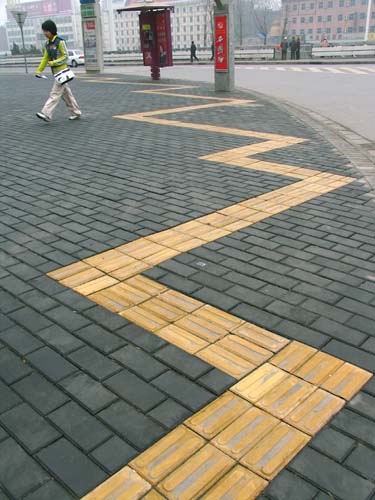

Some tactile guideways are weirdly laid. Picture on the left shows a part of tactile guideways in the city of Xi'an. In a linear distance of some 20 meter, twelve left and right turns will a blind person have to come across. Putting aside all the technical difficulties, this non-humanity design will not considered helpful by any blind person, will only exist in order to make up the so-called "Barrier-free" sidewalk. Some are laid incorrectly, conflict to other permanent settings on the sidewalk. Picture on the middle show one case of a thousand. According what I've seen on the Internet and in real life, tactile guideways are often blocked by trees, mailboxes, sentry boxes, streetlamp, phone booth - you name it. Most of these cases are very dangerous for people relying on and walking on tactile guideways. Some are blocked by cars and bicycles, as shown in the picture at the bottom, indicating that people are not aware of the existence of tactile guideways. Government spent enormous amount of money on laying these yellow bricks, but failed to inform people about their significance. As a result, hardly blind people are making use of this tremendous project, leaving these yellow lanes decorations.
Government are satisfied with the growing number of city laid tactile guideways. People are happy and positive about tactile guideways and the convenience it brings to blind people. What will a blind person think of the unhelpful tactile guideways? Their not using it would be the silence response. It seems like Chinese cities are making big efforts toward accessibility. The process takes time. With future improvements to its design and further public awareness of its significance, tactile guideways may become immensely, practically more useful for those who are visually impaired.

No comments:
Post a Comment